Showing posts with label Book. Show all posts
May 22, 2016
Showcase Presents: Phantom Stranger Vol. 1
Read this book, for it is...THE PHANTOM STRANGER!
The Phantom Stranger Vol. 1 covers the character's series from 1969-1972. Early writing duties fall mainly to Mike Friedrich, and later to Len Wein, Gerry Conway, and Robert Kanigher. The character takes a while to find his feet, but once he does, the book is really good.
Once he is established, the Phantom Stranger is a supernatural being who shows up to stop evil supernatural stuff. His speech reminds me of Storm from the 90s X-Men cartoon (which is a hilariously good thing), and at times he seems to have limitless power. However, a good punch to the face takes him out more than once. This usually happens while he's monologuing to the bad guy about how they can never defeat the power of righteousness.
The earlier stories are not as interesting, as the character is simply a guy who shows up and disproves supernatural phenomenon. These stories get old fast, because there's not actually any spooky stuff going on, and the Stranger himself appears to just be a random guy who shows up and talks a lot without actually doing anything.
Later on, real stuff starts happening, and the Stranger becomes way more engaging with cool powers and abilities. There is some sense of continuity, as he runs into the same two antagonists more than a few times. Tala is a female "Queen of Evil," and manipulates mortals into performing evil deeds. Tannarak is a sorcerer who needs to steal mortal life in order to extend his own. Outside of those two, there's so much crazy supernatural stuff that the Stranger has to extinguish or send back to the abyss. It made for very good reading.
The Stranger usually comes out on top, leaving a strong moral message for those who remain after the battle, though the evil escapes most of the time.
Dr. Thirteen is a huge part of this book. He is another opponent of evil, although his ultimate goal is to disprove all instances of supernatural activity. At first, he and the Stranger are in all the stories together. This quickly becomes formulaic and overused. It's even more baffling early on when he and the Stranger are essentially the same character, since the Stranger seemingly has no powers. Thankfully, they go their separate ways eventually and have individual adventures. Of course, nearly everything Dr. Thirteen runs into turns out to be fake, and everything the Stranger encounters is real, thereby reinforcing each of their convictions.
Early artwork is a mixture of Bill Draut, Mike Sekowsky, and Neal Adams. Later on, it's Jim Aparo and Tony DeZuniga. It's all pretty great. It's interesting to note how artwork from the same period can be so lame or awesome depending on the book. Artists seemed to be given more freedom with the horror stuff, compared to the superhero lineup.
Overall, it was great. The early stuff had me wary to continue, but I'm glad I did. The Stranger is an interesting character, and I find it impressive that DC has kept his true origins and backstory a complete mystery. He truly is a phantom stranger.
April 17, 2016
Nintendo 64 Anthology - The Ultimate Book (Kickstarter)
This Kickstarter caught my eye the other day. It boasts almost 400 pages, 388 game reviews, interviews, a complete history, and various odds and ends. It seems pretty legit, especially since it's already been published in France. This Kickstarter seems to be a means to get it printed and sold in English.
When I read "already published in France," I initially feared the worst: was this a Pix'n Love Publishing book? Thankfully, the answer is no. It is translated from the Geeks-Line version of the book, which is another company that publishes video game-related books in France.
HOWEVER!
The current director of Geeks-Line is Jean-Marc Demoly. This is not good! He is the one who jumped ship from Pix'n Love Publishing a few years ago after the shit hit the fan, the international side of the company was left in ruins, and people had their money stolen. You can read about that in this post.
There is a little bit of credibility here though, because Geeks-Line is supported by retrogamescollector for this project, and they seem to be a good group of folks. I hope they hold Geeks-Line accountable if this project succeeds. As of now, it still has 26 days to go and is already half funded. Things are looking pretty good on the funding front. Let's just hope backers don't get a bunch of empty promises/wallets once the campaign is over.
So it's really up to you whether or not you take the risk. That's true of any Kickstarter. People get burned now and again, but there are plenty of projects that have no issues whatsoever. You look at the creator's pitch, their background, and make your own decision. I would think that reprinting a book that's already done, just in a different language, wouldn't be so hard compared to creating it from scratch. But with Demoly's track record, we'll see.
If you want to check out the actual physical book, albeit in French, you can see this unboxing video.
Kickstarter Link: Nintendo 64 Anthology - The Ultimate Book
March 5, 2016
Videogames: In the Beginning
Videogames: In The Beginning is the story of home video games told by the man who created them. Ralph H. Baer was an electronics whiz and inventive pioneer. He asserts that he is the sole inventor of video games used in our homes. What started as a small side project eventually turned into the mega billion dollar industry we see today.
But please know what to expect if you decide to read this book. It is the story of the man during his time spent with his inventions. It is by no means an anthology of games of that era. Baer only talks about his personal experiences, tinkering, and triumphs. If he wasn't there, he won't talk about it. This leads to an extremely informative piece about the man and his personal work, but nothing else. There's a lot about the Magnavox Odyssey, but virtually nothing about other 1970s or 1980s consoles, of which there are many. The only time he discusses Atari is to bash Nolan Bushnell. Nintendo is mentioned in passing maybe once. Arcade games are addressed, but aren't really important unless it was one he was personally working on. Baer wasn't at other companies or development teams, so they are of no concern to this book. He can be quite dismissive at points, often pointing to the fact that he holds the patents, so there can be no further argument. Again, do not expect a history of early video games in general. Expect a history of what Baer did and thought. The book title is slightly misleading.
He is a very organized man, to put it lightly. He kept documentation, meticulously filed, of practically every semi-significant event that happened during his career. Countless times throughout the book, he will present scans, schematics, documents, letters, memos, pictures, and the like of every topic he discusses. This is a huge feat in itself, since many of these events occurred 50+ years ago. It's a great supplement to the story of his working life. There's also a lot of technical talk interspersed throughout the book. Baer is really writing this book for himself. If you want to read it, feel free, but know that it's really not geared for "how many copies can it sell?" Baer wants his story told his way. He wants all the information out there, direct from the source. And there is so much detail.
The man was extremely successful throughout his career. He held many patents that basically gave him and the company he worked for total control over any home video game that hit the market. He came up with the ideas before anyone else (according to him), and has all the documentation to prove his claim. This helped immensely in court cases fighting for ownership of ideas, licenses, and royalties. Even if some ideas weren't used at the time, he still held the patents and would often collect later. He was innovative alone, but also knew who to talk to if he was having trouble getting his ideas to work the way he wanted. If someone else helped him develop something, he won't throw them under the bus. He was definitely a pioneer for the video game industry.
However, Baer definitely has an ego. A huge ego. At times he'll try to downplay his contributions, but a short time later will express annoyance that people are not giving him credit where he feels it's due. He invented a lot of stuff, and is proud of his ideas. I completely understand that. Why shouldn't he take pride in his accomplishments? However, for nearly every invention he talks about, there are at least one of the following things that apply (according to him):
1. It was ten years ahead of its time
2. It worked remarkably well
3. Every single person who saw it was incredibly impressed
4. The reason it didn't take off was because of some corporate moron(s)
This song and dance is fine for the first couple of inventions he talks about, but when I'm still reading the same things fifty inventions later, it's exhausting. And it's not like he wasn't successfully financially or in being recognized for his achievements. He wasn't a minimum-wage drifter struggling to make ends meet. He was Chief Engineer for Equipment Design at a large electronics defense contractor. Video games started as a tiny side project. Many times he talks about how his early success and "internal credit" gave him complete freedom to do whatever he wanted with corporate resources, while at the same time collecting two/three substantial paychecks. The "woe is me" speech doesn't really work when in the next paragraph you state your first royalty check for video games was $500,000 and the company you work for pulled in over $100 million from lawsuits based on your work. He received the National Medal of Technology, was inducted into the National Inventors Hall of Fame, and has a permanent display at the Smithsonian among other museums around the world. I think he made out pretty well.
Since this is a book written by Baer about Baer, I don't doubt that there are exaggerations. I also don't doubt that some events are retold with a spin in his favor. He does not hold back for anyone or anything. It really gets spiteful at some points. He wants the world to know what he thinks about how his ideas turned out. He's not too worried about sparing feelings or making friends. If he thinks someone was a total asshole twenty years ago, he'll tell you about it. And unfortunately, the very beginning the book is not a good set-up for the rest. Baer expresses his irritation of not being recognized enough, even throwing personal insults at people he doesn't even know. I almost didn't continue, because it was nothing less than a tirade against the internet. In a place where it has never been easier to spread misinformation without any repercussions, he is yelling at the internet to change its tune.
The book itself is a large paperback with blocks of text broken up by pages of schematics or pictures. The layout isn't the greatest, but it gets the job done. The chronology is a little off too. Baer will often jump back fifteen years to talk about something he forgot to mention earlier. There's also a lot of tangential thoughts that just kind of enter whenever they feel like it. It works at the end of the day, but with a little more editing the book could have been much more professional.
Bottom line? It's a great book if you're interested in what Baer accomplished in those early years. If you want to see actual diagrams and have detailed explanations of exactly what he was inventing, then pick it up. You'll never find anything better. If you're looking for a full, unbiased history of early home video games, the absolutely skip this one.
December 20, 2015
Legends of Localization - Book 1: The Legend of Zelda (Part 2)
Check out Part 1 if you missed it.
After the First Quest, the Second Quest is explored. There are a bunch of differences between the gameplay, so naturally there are a bunch of text differences as well.
Items are looked at next. A basic list of Japanese and English names for items are placed side-by-side for comparison. A few are looked at more in-depth. Rupee vs. Rupy, Wooden Sword vs. Sword, Recorder vs. Flute, and Book of Magic vs. Bible for example.
Next are enemies. These include Wizrobes, Like Likes, Zoras, Darknuts, and Manhandla. The origins and surprises of some of these enemies was very interesting. Mato has definitely done his homework.
The second large chapter of the book discusses the manual. Obviously, the FDS and NES are totally different formats, so there's a lot of expected differences there. This includes loading times and saving your game. Outside of that, though, the text is mostly the same. Promo art is also the same, although screenshots of gameplay are different.
The manual and the game localization were most likely handled by an entirely different team, which is why there's so many discrepancies between the two. Since there was only so much space on a game cart/disk, a lot of extra information was included in the manual. This was one of my favorite parts of this book. It's also not hard to see why there are so many inconsistencies throughout, as "translating games without playing them first is very common...most translators get a few spreadsheets with text to translate and that's it."
The penultimate chapter looks at items outside of the game for reference. This includes promotional material (often provided by companies outside of Nintendo), prototype versions, board games, Game & Watch, guide books, magazines, and TV commercials among other things. Very cool stuff.
The final section is a little bit of personal thoughts from Mato about the whole thing. It's not very long, and is a nice final touch for the book. There are also a number of places shown to explore more game history, as well as additional Zelda lore.
It's really nice that Mato touches on games that had an influence on Zelda or vice versa, and includes screenshots and examples to illustrate the point. It's also great that he digs into the "why" of things, instead of just stating "they translated it this way, the end." He really wants to reader to understand why certain changes were made, because there's usually a good reason.
And again, Fangamer outdoes itself with the quality of this tome. Hardcover with gold foil imprinting, and cool obi strip. The book clocks in at just over 200 pages.
Conclusion:
This books works extremely well for two reasons.
It makes the whole thing a very engaging and insightful read. It's not too dry, but it's also not too loose. It's a really good balance. He has a good voice, and speaks succinctly while at the same time being very informative . I can't recommend this book enough. Pick it up!
After the First Quest, the Second Quest is explored. There are a bunch of differences between the gameplay, so naturally there are a bunch of text differences as well.
Items are looked at next. A basic list of Japanese and English names for items are placed side-by-side for comparison. A few are looked at more in-depth. Rupee vs. Rupy, Wooden Sword vs. Sword, Recorder vs. Flute, and Book of Magic vs. Bible for example.
The second large chapter of the book discusses the manual. Obviously, the FDS and NES are totally different formats, so there's a lot of expected differences there. This includes loading times and saving your game. Outside of that, though, the text is mostly the same. Promo art is also the same, although screenshots of gameplay are different.
The manual and the game localization were most likely handled by an entirely different team, which is why there's so many discrepancies between the two. Since there was only so much space on a game cart/disk, a lot of extra information was included in the manual. This was one of my favorite parts of this book. It's also not hard to see why there are so many inconsistencies throughout, as "translating games without playing them first is very common...most translators get a few spreadsheets with text to translate and that's it."
The penultimate chapter looks at items outside of the game for reference. This includes promotional material (often provided by companies outside of Nintendo), prototype versions, board games, Game & Watch, guide books, magazines, and TV commercials among other things. Very cool stuff.
The final section is a little bit of personal thoughts from Mato about the whole thing. It's not very long, and is a nice final touch for the book. There are also a number of places shown to explore more game history, as well as additional Zelda lore.
And again, Fangamer outdoes itself with the quality of this tome. Hardcover with gold foil imprinting, and cool obi strip. The book clocks in at just over 200 pages.
Conclusion:
This books works extremely well for two reasons.
- Mato is very knowledgeable about Japanese translation and localization.
- He knows the game itself inside and out. He could probably write a book just on the gameplay/secrets/etc. and not touch localization at all.
It makes the whole thing a very engaging and insightful read. It's not too dry, but it's also not too loose. It's a really good balance. He has a good voice, and speaks succinctly while at the same time being very informative . I can't recommend this book enough. Pick it up!
Labels:
Book,
Legend of Zelda,
Localization,
Mato,
Nintendo,
Review,
Zelda
Legends of Localization - Book 1: The Legend of Zelda (Part 1)
Clyde Mandelin's site Legends of Localization is a gold mine for anyone interested in the Japanese side of video games released worldwide. He is living the dream that I'm sure many people have: being able to translate video games, manga, and anime professionally. His site has been up for years, but it's only recently that's he published a book in collaboration with the wonderful people at Fangamer. I'll only be talking about the book in this post, but I highly encourage you to check out Mandelin's site for a huge amount of content.
Mato (as he will be referred to from now on) starts off by telling the reader the book isn't going to be a boring text book, but rather "...a good mix of serious research, critical analysis, and a casual, laid-back attitude." Thankfully, he delivers. There have been more than a few books about video games that rely way too much on personal nostalgia and biographical info of the author, which really take all interest away from the subject at hand (I'm looking in your direction, Boss Fight Books). Mato keeps the biography stuff short and sweet. It's right in the Introduction and only runs for a few pages. Fine with me. The only other spot for personal tidbits is tiny little captions here and there. I can't praise him enough for keeping his personal life out of the writing. It's The Legend of Zelda, not The Legend of Mato, so thank you for keeping it that way.
Next up is graphics. Obviously the title screen is different, but there are some font changes as well within the game. This whole section is pretty short, and it covers tiny miscellaneous things like the Name Entry text, the Zora sprite, and a couple of other things. Honestly, this section could have fit neatly into the chapter titled "First Quest," especially since the title screen and text are covered in more detail anyway. It kind of stands weirdly on its own.
Gameplay is next. Mato discusses why English text is so prevalent in Japanese games, and why they choose to use certain English quirks a lot of the time. Most of this section focuses on differences you'll encounter before really even starting the game, as well as how hardware difference affect the game itself (à la Pols Voices). Each subsequent port of the first Legend of Zelda is either based on the Disk version or the Cart version. And whichever the case, it carries over the same minor gameplay differences from the source material. There has never been a solid "definitive version," which I think is pretty neat.
Finally, we reach text. This is probably where most people think localization takes place first. Since Mato is a professional translator and has the résumé to back it up, he is a fully credible source to discuss this (not to mention write this book in the first place). Firstly, he talks about how Japanese people use different speech patterns and dialects based on gender, age, politeness, etc. and how it can get lost in the translation process. He then explores various instances where the translators did good jobs and bad jobs of conveying the original intended text and nuances. This is the longest section in the book, so there's too much to explain in this post. Countless instances of what was changed, the reason(s) why, and whether or not the localization succeeded. Players often think of the poorly translated lines first since they stand out so much. What are the actual original lines in Japanese? Do they make more sense in their native language? Surprisingly, sometimes the answer is still "no."
Continued in Part 2...
Labels:
Book,
Legend of Zelda,
Localization,
Mato,
Nintendo,
Review,
Zelda
November 22, 2015
Push > Start
The Art of Video Games.
Push > Start is a large art book showcasing a wide time span of video games. There are a total of 215 games showcased, starting way back with OXO (1952) and finishing with Halo 5 (2015). Since it covers over sixty years, there are a few games that aren't covered (*gasp*).
However, the focus isn't on the games themselves, but rather the art and style presented within each one. Each game is showcased by only one or two screenshots. That's it. The only information provided on each game is the platforms it was released for, year, developer, and composer. The only block text present is a short introduction at the beginning of each chapter and some philosophical explication at the end. The chapters are separated as follows:
- Early Games
- Arcades
- 8-Bit
- 16-Bit
- 3D
- HD
- Video Game Platforms
- The Art of Video Games
All in all, it's a nice simple snapshot of each era. Clearly, it's difficult to make a statement like, "I'm going to narrow down the entire 8-Bit era to fifty games." But for the most part, the games chosen were pretty safe.
As the book nears the more recent time periods, though, it becomes much more subjective. Games can be a cash cow, and publishers know that. It is not (and has not been) a niche market for a large number of years. It makes it way harder to determine which games have blood, sweat and tears put into them to make them "artistic" and which ones have enough money/manpower/marketing to give it the illusion of being so. Or maybe some of them are anyway. Who can say? Nobody, because it's not a fact, it's an opinion, so quit your whining. Everyone likes their own thing, and there's way too much to be able to see everything.
The philosophy stuff is a little tiring, and thankfully there's not too much. People trying to quantify things that can't (and shouldn't) be quantified into "fact." Here's a taste:
"A game is art because it adds a new element to the "vocabulary" of design. One day, the artists who created this pure, controlled image space may well be mentioned in the same breath as Michelangelo or Leonardo."
The difference is, Miyamoto wasn't some hipster sitting at home trying to avant-garde the crap out of the industry/society. He went to school, got a job, and was tasked by his superiors to make a product that would sell, and so he based it off of existing popular things. Yes, he was innovative. Yes, he was smart. Yes, he had skill. But he wasn't sitting down saying to himself, "God, I'm going to make such an artistic statement out of this thing." But he put in real, full effort, and it turned out great. So we appreciate it. End of story.
The book itself is gorgeous and high quality, not to mention huge! It measures approximately 11" x 11", and weighs over six pounds. The cover is embossed with a checked pattern and includes an obi strip. The organization is great, as the index is up front for easy navigation.
There is also a vinyl record included in the back with generic "big game" music remixes on it (think Super Mario Bros., Castlevania, Street Fighter, Mega Man 2, Tetris, etc.). Not a huge deal, and the remixes are fairly lackluster. I would guess that they did remixes since putting the source music on there would cost way too much money. But with a remix they can argue artistic license or whatever.
It's definitely an "artsy" art book rather than a diagnosis of the art of video games. Worth it? Well, it looks really nice. Not any huge surprises, but aesthetically they nailed it. So if that's what you're going for, spend away.
November 1, 2015
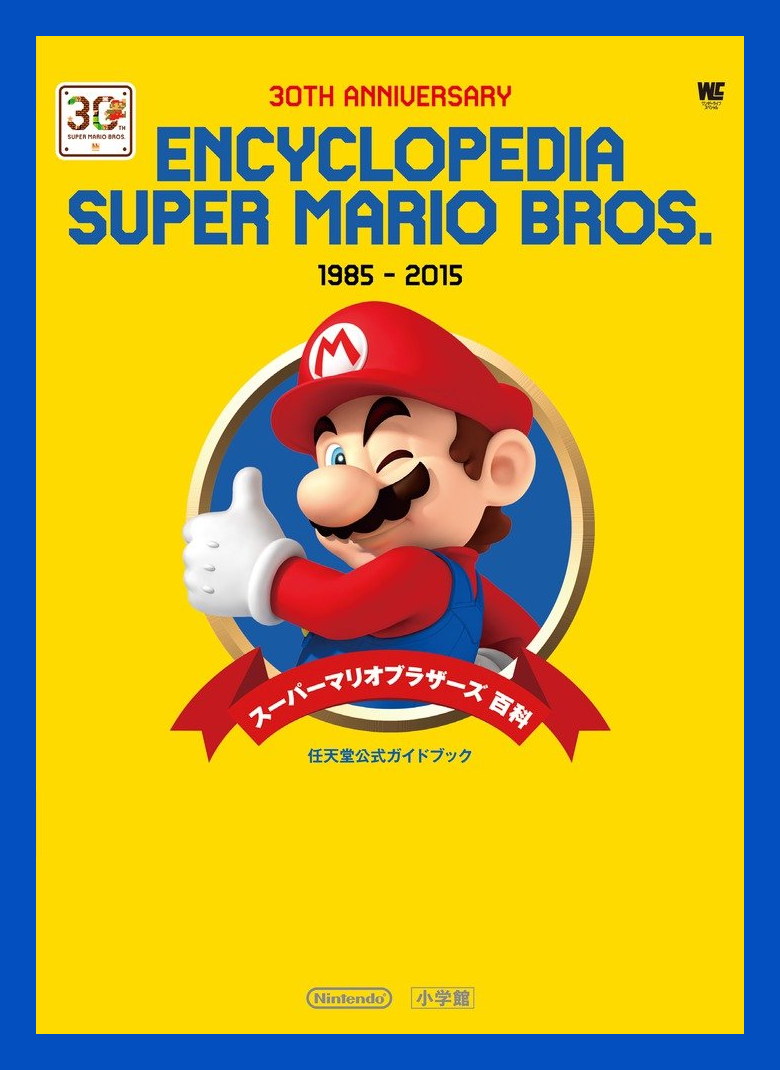
Super Mario Bros. 30th Anniversary Encyclopedia
This book follows in the footsteps of Hyrule Historia and the Kirby 20th Anniversary Book in that it celebrates the main points of Mario's game history. It covers the following:
- 1985 - Super Mario Bros.
- 1986 - Super Mario Bros. 2
- 1988 - Super Mario Bros. 3
- 1989 - Super Mario Land
- 1990 - Super Mario World
- 1992 - Super Mario USA
- 1992 - Super Mario Land 2: 6 Golden Coins
- 1996 - Super Mario 64
- 2002 - Super Mario Sunshine
- 2006 - New Super Mario Bros.
- 2007 - Super Mario Galaxy
- 2009 - New Super Mario Bros. Wii
- 2010 - Super Mario Galaxy 2
- 2011 - Super Mario 3D Land
- 2012 - New Super Mario Bros. 2
- 2012 - New Super Mario Bros. U
- 2013 - Super Mario 3D World
- 2015 - Super Mario Maker
It clocks in at 255 pages, and is quite a good read. Granted, it cannot go super in-depth for all of the above titles, because that would take a much larger volume than this. But it is a great book nonetheless.
There are a ton of visuals, which is a huge part of what makes this book stand out. Each game has official artwork from the manual/guide book/etc., as well as many screenshots. Personally, it's great having so much of Shigefumi Hino's high-quality artwork in one place. Super Mario World still has my favorite design out of any Mario game, and I love that the current official 2D art style has gravitated back to that era.
- Introduction
- Characters
- World
- And More
The "Introduction" gives a brief synopsis of the story, what's going on, why Mario is there, etc. Pretty self-explanatory. The "Characters" section presents all the good guys and bad guys, along with a short explanation of each. The "World" section shows all of the areas Mario will travel through, as well as environmental hazards and objects he may encounter. Finally, the "And More" section has some trivia facts, secrets, and even some ways to glitch each game. Neat-o.
It's pretty crazy to look at an entirety of a Mario game over a few pages. It makes you realize how much content there really is inside of each one. I tend to spend the most time in the retro games section, because that was the period in which I grew up, and it's where I have the most interest. I imagine younger readers are more likely to stick to the newer games.
Even though this book cannot cover every Mario game in detail, there is a section in the back that lists almost every game he has appeared in. It even includes cameo appearances in games like Majora's Mask.
The only ones missing are the really obscure games of which we do not speak.
There are also small sections scattered throughout of interesting facts, merchandise info, and interviews. Just makes the book that much more worth it. I will note that Tezuka seems much more open to interviews than Miyamoto as of late. Which is totally fine, they are both right up there in the creative process. It's just interesting to note.
One of my favorite parts of this book has to be the front inside of the dust cover. It is the same illustration of the Super Mario Collection official guide book printed way back in 1993! I prefer it over the dust cover. I'm sure it helps that Shogakukan has been publishing official Nintendo guide books since the Famicom era. Too cool.
I am hoping this book will be localized, and I would think that if Hyrule Historia can have it done, so can this. Nintendo seems to want to celebrate Mario's 30th Anniversary equally around the world, so there is still hope.
June 29, 2015
Showcase Presents: Strange Adventures Vol. 1
Hang on a second, some of this doesn't make sen--THE END.
Strange Adventures Vol. 1 presents the book's run from issues #54-73. There are about four stories per issue, which means that they're all really short, coming in at six pages or less.
This wouldn't necessarily be a bad thing. There are plenty of DC stories from the same time period with good short stories. However, Strange Adventures doesn't even seem to try in terms of narrative. Here's what the process feels like:
WRITER: "Hey, I've got the start of an idea!"
EDITOR: "You have twenty minutes to get the full final copy on my desk."
Almost every single story is a half-thought idea that really doesn't go anywhere. It seems like they threw whatever was left over from other books into this one. The fact that writers come and go every single issue makes the case even stronger.
![]() |
| Somebody was paid to come up with this "idea." |
I wanted to like this book so bad. I love the goofy Silver Age stories, but there was absolutely no substance to any of these. The only good thing about any of them are the titles. Just by reading some of those, there is so much wasted potential:
The Gorilla who Challenged the World
The Day the Sun Exploded
I Hunted the Radium Man!
The Invisible Masters of Earth!
The Super-Athletes from Outer Space!
The Man Who Remembered 100,000 Years Ago!
I Was the Man in the Moon!
The Man Who Discovered the West Pole!
The Flying Raincoat!
The Talking Flower!
The Man Who Couldn't Drown!
The Man with Four Minds!
Raiders from the Ultra-Violet!
The Man Who Ate Sunshine!
The Skyscraper that Came to Life!
All of the stories end abruptly and unexpectedly. There are so many questions unanswered, and there's usually one panel that desperately attempts to cram in the "explanation" of the entire plot. But there is no plot. Just a huge waste of time. I walked away from each story feeling one of three things:
- Very mild amusement
- Anger
- Total indifference
![]() |
| Of course! How could I have been so blind? |
The only counter-argument I find of why these stories are so lame is because they were written for young children. But even if I were eight years old, I would still be pissed at the total incoherency and lack of effort. The artwork doesn't offer much either. All of the people look the same, in the same static poses, never really doing anything.
![]() |
| Pictured: Logic, apparently. |
Let me walk you through a story. I can do it quite fast, since there's nothing there to begin with:
1. The government is seeking defense against foreign guided missile attacks
2. An inventor creates a ray that will create a force field around a city
3. He tests it out. Inexplicably, gems rain from the sky, and people collect them
4. The gems exert telepathic commands, controlling people to take over the city
5. The inventor disables the evil gem by shooting his ray (in reverse) directly at it
6. THE END
![]() |
| I just want to punch someone. |
Seriously, that's all there is to it. It's just so stupid. There are blind attempts to clumsily explain why shit is happening, but they never actually clarify anything. In fact, they usually just make it worse. Just thinking about it makes me mad.
![]() |
| There can be no other explanation. |
Since this book runs smack-dab in the middle of the Atomic Age, nearly every story includes invasion by aliens, some kind of good/bad radiation, or the intense power of America's A-Bomb/H-Bomb. The very thinly veiled Soviet Union fear runs rampant.
![]() |
| IT'S. SO. SUBTLE. |
Bottom line? Skip it. Just skip it. I am incredibly surprised that not one, but two volumes of Strange Adventures are included in DC's Showcase Presents TPBs. Why, when there are so many other worthwhile things?
Subscribe to:
Posts (Atom)