Showing posts with label Nintendo. Show all posts

June 7, 2017

Pixel Painting - Pixel Pikachu (Pokémon Mystery Dungeon)


This painting was done as a donation to a local fundraiser. This was my contribution to a Pokémon-themed prize pack. It's a decent size at 20"x20".

I searched through many Pokémon games to find the exact style of sprite I was looking for. After searching through the highly recommended Spriters Resource, I decided on a sprite from Pokémon Mystery Dungeon: Explorers of Time/Darkness on the Nintendo DS.


I changed up the usual background too. I went back to basics and found the grass tiles from Pokémon Red/Blue/Yellow and colorized them myself. I like the way it turned out, and it's way more interesting than the standard solid color or gradient shading background.

Commissions are always welcome. Price varies based on the size and complexity of the sprite/scene. I moderate comments, so feel free to leave one with your contact email and request and I'll get back to you ASAP.

April 17, 2016

Nintendo 64 Anthology - The Ultimate Book (Kickstarter)


This Kickstarter caught my eye the other day. It boasts almost 400 pages, 388 game reviews, interviews, a complete history, and various odds and ends. It seems pretty legit, especially since it's already been published in France. This Kickstarter seems to be a means to get it printed and sold in English.

When I read "already published in France," I initially feared the worst: was this a Pix'n Love Publishing book? Thankfully, the answer is no. It is translated from the Geeks-Line version of the book, which is another company that publishes video game-related books in France.

HOWEVER!

The current director of Geeks-Line is Jean-Marc Demoly. This is not good! He is the one who jumped ship from Pix'n Love Publishing a few years ago after the shit hit the fan, the international side of the company was left in ruins, and people had their money stolen. You can read about that in this post.


So should you back this book? I'm on the fence. Geeks-Line has backed zero projects, and this is their first created project. But I'll give them the benefit of the doubt. Though, this Kickstarter of the Another World book didn't even come close to their goal, partly because of the negative feelings people had towards Pix'n Love Publishing. Is this just the same scam under a different name? That really seems to be Demoly's game.

There is a little bit of credibility here though, because Geeks-Line is supported by retrogamescollector for this project, and they seem to be a good group of folks. I hope they hold Geeks-Line accountable if this project succeeds. As of now, it still has 26 days to go and is already half funded. Things are looking pretty good on the funding front. Let's just hope backers don't get a bunch of empty promises/wallets once the campaign is over.

So it's really up to you whether or not you take the risk. That's true of any Kickstarter. People get burned now and again, but there are plenty of projects that have no issues whatsoever. You look at the creator's pitch, their background, and make your own decision. I would think that reprinting a book that's already done, just in a different language, wouldn't be so hard compared to creating it from scratch. But with Demoly's track record, we'll see.

If you want to check out the actual physical book, albeit in French, you can see this unboxing video.

Kickstarter Link: Nintendo 64 Anthology - The Ultimate Book

January 1, 2016

Wii U - Year Three Conclusion


More applause.

Another year down. Time really flies, you know? My Wii U collection almost rivals that of the Wii, which seems odd at points. But then after really thinking about it, there was so much shovelware and crap on the Wii, so it just looks like there's more content. I'm glad the sheer amount of garbage went down for the Wii U. Any that really pops up is limited to the eShop anyway, which is much nicer I think.

Some really good stuff over the past year, some worthwhile DLC, and a better amiibo situation (finally).

Favorite games released in 2015?

Retail:


eShop (not including Virtual Console):


Backlog:


Games that should be on the list, but were just an overall disappointment that didn't even come close to reaching their potential:


Xenoblade Chronicles X took up most of my time. I cannot walk away from that game. So close to getting 100% map completion. I think once that happens, I will finally be able to put the game down. Super Mario Maker is also a game I can't seem to put down. And with all the continued updates, it doesn't look like that will change any time soon. No complaints on this end.

Better third-party support this year, but I could still use more. Hopefully the NX will fix some of that. And that is right on the horizon, which is crazy to think about.

I'm hoping this blog will still be active then, too.

December 20, 2015

Legends of Localization - Book 1: The Legend of Zelda (Part 2)

Check out Part 1 if you missed it.

After the First Quest, the Second Quest is explored. There are a bunch of differences between the gameplay, so naturally there are a bunch of text differences as well.


Items are looked at next. A basic list of Japanese and English names for items are placed side-by-side for comparison. A few are looked at more in-depth. Rupee vs. Rupy, Wooden Sword vs. Sword, Recorder vs. Flute, and Book of Magic vs. Bible for example.


Next are enemies. These include Wizrobes, Like Likes, Zoras, Darknuts, and Manhandla. The origins and surprises of some of these enemies was very interesting. Mato has definitely done his homework.


The second large chapter of the book discusses the manual. Obviously, the FDS and NES are totally different formats, so there's a lot of expected differences there. This includes loading times and saving your game. Outside of that, though, the text is mostly the same. Promo art is also the same, although screenshots of gameplay are different.


The manual and the game localization were most likely handled by an entirely different team, which is why there's so many discrepancies between the two. Since there was only so much space on a game cart/disk, a lot of extra information was included in the manual. This was one of my favorite parts of this book. It's also not hard to see why there are so many inconsistencies throughout, as "translating games without playing them first is very common...most translators get a few spreadsheets with text to translate and that's it."


The penultimate chapter looks at items outside of the game for reference. This includes promotional material (often provided by companies outside of Nintendo), prototype versions, board games, Game & Watch, guide books, magazines, and TV commercials among other things. Very cool stuff.


The final section is a little bit of personal thoughts from Mato about the whole thing. It's not very long, and is a nice final touch for the book. There are also a number of places shown to explore more game history, as well as additional Zelda lore.

It's really nice that Mato touches on games that had an influence on Zelda or vice versa, and includes screenshots and examples to illustrate the point. It's also great that he digs into the "why" of things, instead of just stating "they translated it this way, the end." He really wants to reader to understand why certain changes were made, because there's usually a good reason.


And again, Fangamer outdoes itself with the quality of this tome. Hardcover with gold foil imprinting, and cool obi strip. The book clocks in at just over 200 pages.

Conclusion:

This books works extremely well for two reasons.

  • Mato is very knowledgeable about Japanese translation and localization.
  • He knows the game itself inside and out. He could probably write a book just on the gameplay/secrets/etc. and not touch localization at all.

It makes the whole thing a very engaging and insightful read. It's not too dry, but it's also not too loose. It's a really good balance. He has a good voice, and speaks succinctly while at the same time being very informative . I can't recommend this book enough. Pick it up!

Legends of Localization - Book 1: The Legend of Zelda (Part 1)


Secret power is said to be in the localization.

Clyde Mandelin's site Legends of Localization is a gold mine for anyone interested in the Japanese side of video games released worldwide. He is living the dream that I'm sure many people have: being able to translate video games, manga, and anime professionally. His site has been up for years, but it's only recently that's he published a book in collaboration with the wonderful people at Fangamer. I'll only be talking about the book in this post, but I highly encourage you to check out Mandelin's site for a huge amount of content.

Mato (as he will be referred to from now on) starts off by telling the reader the book isn't going to be a boring text book, but rather "...a good mix of serious research, critical analysis, and a casual, laid-back attitude." Thankfully, he delivers. There have been more than a few books about video games that rely way too much on personal nostalgia and biographical info of the author, which really take all interest away from the subject at hand (I'm looking in your direction, Boss Fight Books). Mato keeps the biography stuff short and sweet. It's right in the Introduction and only runs for a few pages. Fine with me. The only other spot for personal tidbits is tiny little captions here and there. I can't praise him enough for keeping his personal life out of the writing. It's The Legend of Zelda, not The Legend of Mato, so thank you for keeping it that way.


The first section is focused on audio. The differences between the FDS and NES hardware is briefly explained, and is followed by several examples of where the music is different. To make things easier, Mato provides a QR code (or you could just go to his site and listen) for the actual audio comparisons. Next, some sound effect changes are explored. These include Sword Shooting, picking up rupees/hearts/items, doors opening, enemies dying, and the like. Some of the changes are not that big, while other sounds could not be more different. It's pretty interesting. There are also waveform comparisons in the book, which I suppose is the next best thing to the actual audio. The NES seems to make way more use of the DPCM channel in an attempt to compensate for the lack of channels the FDS supports.


Next up is graphics. Obviously the title screen is different, but there are some font changes as well within the game. This whole section is pretty short, and it covers tiny miscellaneous things like the Name Entry text, the Zora sprite, and a couple of other things. Honestly, this section could have fit neatly into the chapter titled "First Quest," especially since the title screen and text are covered in more detail anyway. It kind of stands weirdly on its own.


Gameplay is next. Mato discusses why English text is so prevalent in Japanese games, and why they choose to use certain English quirks a lot of the time. Most of this section focuses on differences you'll encounter before really even starting the game, as well as how hardware difference affect the game itself (à la Pols Voices). Each subsequent port of the first Legend of Zelda is either based on the Disk version or the Cart version. And whichever the case, it carries over the same minor gameplay differences from the source material. There has never been a solid "definitive version," which I think is pretty neat.


Finally, we reach text. This is probably where most people think localization takes place first. Since Mato is a professional translator and has the résumé to back it up, he is a fully credible source to discuss this (not to mention write this book in the first place). Firstly, he talks about how Japanese people use different speech patterns and dialects based on gender, age, politeness, etc. and how it can get lost in the translation process. He then explores various instances where the translators did good jobs and bad jobs of conveying the original intended text and nuances. This is the longest section in the book, so there's too much to explain in this post. Countless instances of what was changed, the reason(s) why, and whether or not the localization succeeded. Players often think of the poorly translated lines first since they stand out so much. What are the actual original lines in Japanese? Do they make more sense in their native language? Surprisingly, sometimes the answer is still "no."


Continued in Part 2...

November 1, 2015

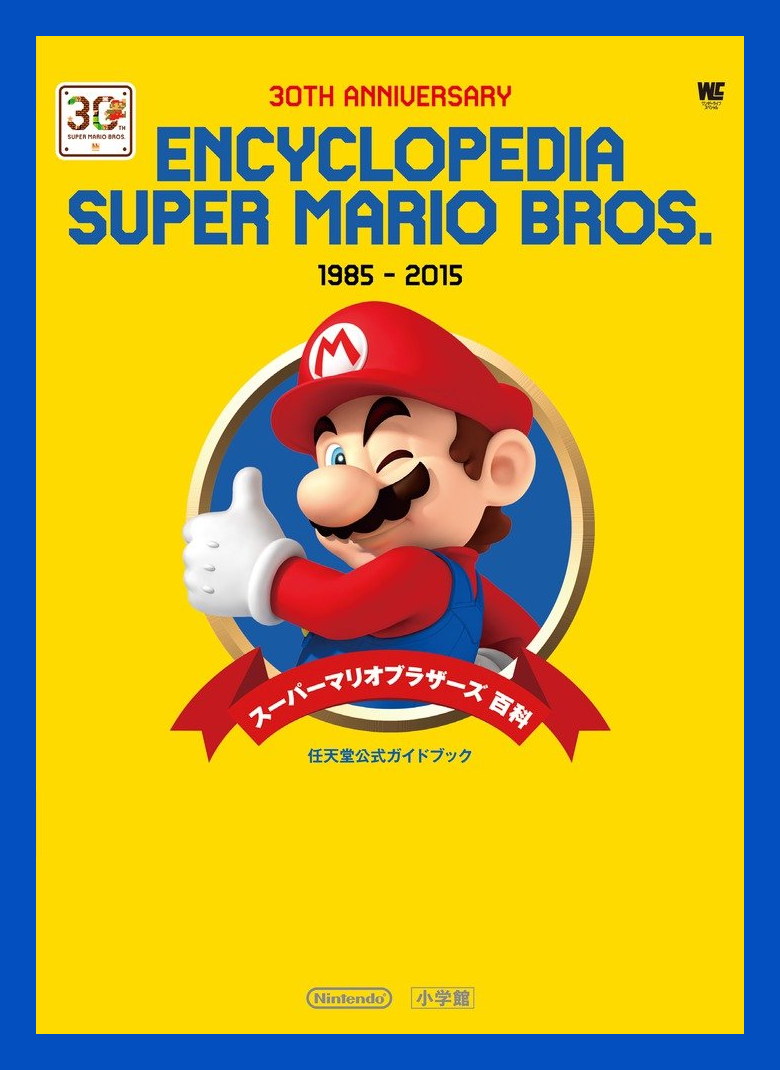
Super Mario Bros. 30th Anniversary Encyclopedia


Super indeed.

This book follows in the footsteps of Hyrule Historia and the Kirby 20th Anniversary Book in that it celebrates the main points of Mario's game history. It covers the following:

  • 1985 - Super Mario Bros.
  • 1986 - Super Mario Bros. 2
  • 1988 - Super Mario Bros. 3
  • 1989 - Super Mario Land
  • 1990 - Super Mario World
  • 1992 - Super Mario USA
  • 1992 - Super Mario Land 2: 6 Golden Coins
  • 1996 - Super Mario 64
  • 2002 - Super Mario Sunshine
  • 2006 - New Super Mario Bros.
  • 2007 - Super Mario Galaxy
  • 2009 - New Super Mario Bros. Wii
  • 2010 - Super Mario Galaxy 2
  • 2011 - Super Mario 3D Land
  • 2012 - New Super Mario Bros. 2
  • 2012 - New Super Mario Bros. U
  • 2013 - Super Mario 3D World
  • 2015 - Super Mario Maker

It clocks in at 255 pages, and is quite a good read. Granted, it cannot go super in-depth for all of the above titles, because that would take a much larger volume than this. But it is a great book nonetheless.

There are a ton of visuals, which is a huge part of what makes this book stand out. Each game has official artwork from the manual/guide book/etc., as well as many screenshots. Personally, it's great having so much of Shigefumi Hino's high-quality artwork in one place. Super Mario World still has my favorite design out of any Mario game, and I love that the current official 2D art style has gravitated back to that era.


The book design is very well thought-out and the whole thing has a nice flow. Each game is split into four sections:
  1. Introduction
  2. Characters
  3. World
  4. And More
The "Introduction" gives a brief synopsis of the story, what's going on, why Mario is there, etc. Pretty self-explanatory. The "Characters" section presents all the good guys and bad guys, along with a short explanation of each. The "World" section shows all of the areas Mario will travel through, as well as environmental hazards and objects he may encounter. Finally, the "And More" section has some trivia facts, secrets, and even some ways to glitch each game. Neat-o.


It's pretty crazy to look at an entirety of a Mario game over a few pages. It makes you realize how much content there really is inside of each one. I tend to spend the most time in the retro games section, because that was the period in which I grew up, and it's where I have the most interest. I imagine younger readers are more likely to stick to the newer games.


Even though this book cannot cover every Mario game in detail, there is a section in the back that lists almost every game he has appeared in. It even includes cameo appearances in games like Majora's Mask.


The only ones missing are the really obscure games of which we do not speak.


There are also small sections scattered throughout of interesting facts, merchandise info, and interviews. Just makes the book that much more worth it. I will note that Tezuka seems much more open to interviews than Miyamoto as of late. Which is totally fine, they are both right up there in the creative process. It's just interesting to note.


One of my favorite parts of this book has to be the front inside of the dust cover. It is the same illustration of the Super Mario Collection official guide book printed way back in 1993! I prefer it over the dust cover. I'm sure it helps that Shogakukan has been publishing official Nintendo guide books since the Famicom era. Too cool.


I am hoping this book will be localized, and I would think that if Hyrule Historia can have it done, so can this. Nintendo seems to want to celebrate Mario's 30th Anniversary equally around the world, so there is still hope.