Showing posts with label Documentary. Show all posts

January 24, 2014

Drew: The Man Behind the Poster


Brilliant.

Drew: The Man Behind the Poster is an in-depth look at Drew Struzan's career and life. His work is timeless, and has impacted more people than almost any other modern artist. So many people are familiar with his work, despite not knowing his name. Here's a few to get you started:


The documentary follows Drew's beginnings as a starving artist to his slow but sure crawl to being one of the most beloved artists in the world. I can't recommend this film enough.

What really makes it work is Drew's willingness to be interviewed. I was afraid that this film would turn into a simple montage of people saying, "Oh, man, I love that poster!" Thankfully, that stuff takes a far backseat to Drew himself talking about his life, experiences, and lessons learned.

Yes, there are interviews from famous actors and others in the film industry, but they're people that genuinely care about Drew and his paintings. They have a lot of insight and sincere love for Drew's work, and it really comes through. There's no needless filler.

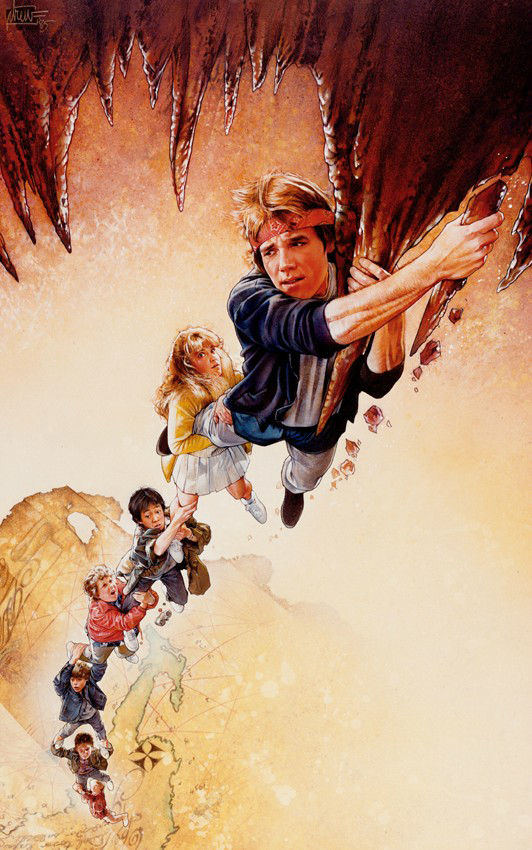


Drew seems like a very private, truthful, and direct kind of guy. He's very trusting (to a fault), and just loves his work. It doesn't matter what subject he's painting, or if he's being paid. He'd do it regardless. His passion for the art is inspiring. Hell, after watching, I wanted to go learn how to paint.

His wife Dylan also provides a lot of insight on their lives and struggles to be in a non-threatening situation life-wise. They're both so candid about everything, it's almost impossible to stop watching. Drew discusses a lot of the stories behind the posters, and the ins and outs of his career.

It's also great to see this in HD, because they show a lot of spectacular close-ups of Drew's work. It's something that can't be replicated through a computer monitor. It really shows the intricate details, color, and textures of the work, and makes the paintings just spring to life.


The last parts of the documentary talk about how most movie posters were shifted from actual artists to computer enthusiasts who could whip something up in Photoshop over a weekend. It's really disheartening to hear not only Drew, but other brilliant movie poster artists tell how they've been cast aside, merely to cut costs.

And it's true. Movie posters, which are normally one of the first things you see (and are supposed to get you to want to see the movie), look so boring and flavorless. Everything looks like everything else. It's just another thing that's fallen to the Hollywood crap of "if you do something once, do it a billion times. Even though it never worked in the first place, keep on doing it, because doing something new requires effort. Don't give people any other option, so they'll be forced into accepting it."

Drew is also shown going to Comic-Con in San Diego in 2010, and the overwhelming response he received (including an Inkpot Award). He is truly speechless, astounded that people came from so far "just to see little old me."


The fact that Drew is still alive also makes the documentary work very well. Too often a project is started after a notable figure has died, because it took their death to get people interested. The creators can't ask questions, because obviously they'd get no answer. Everything has to be constructed from archival material, which is too bad, because these people sat for years unaware that myriads of people still adore their work.

Bottom line? Watch it. Watch it now. It's streaming on Netflix and Amazon. Or you could just go buy it. You won't be disappointed, and to really see how much Drew accomplished over the years is incredible.

The credits make such an impact too. In order to show the posters Drew painted over the years, the filmmakers have to show copyright info and such. The absolutely gargantuan list of work, listed one after another, is mind-boggling. I was completely blown away.

If you decide not to watch the documentary, your loss. But you at least owe it to yourself to check out his website. All the movie stuff is under the Illustrated Works. The art for art's sake is under Studio Works. He also has not one, but two books available. Both are filled with artwork and insights. Truly a master of the art.

Man! If only I had $200,000!

August 12, 2013

Special When Lit


Worth it.

Special When Lit is a documentary about the pinball phenomenon. Being a pinball enthusiast myself, it was a great look into the industry from the inside.

It covers the origins of the game in the late 1700s all the way to modern day, often with interviews and footage of key people involved. Designers, top players, collectors, pinball arcade owners, programmers, and other notables have a lot to say about their experiences over the course of many decades.

It's very cool that designers of some of the most famous tables give some of their time to just talk about what it was like back in the day, the feelings they would have seeing a table complete, and their process for designing something from scratch. The interviews from players were also interesting, and most of them talk about how it's mentally and physically exhausting, and how it truly is a game of skill. Although some of these people are very old, many of them still congregate at expos and large tournaments.

I've watched some arcade game documentaries, and was afraid Special When Lit would fall into focusing too much on the eccentrics. Thankfully, it didn't. Those people make up a tiny part of the whole documentary. Not to say there aren't some strange people out there, but to try and lump all players into that stereotype of the "pinball-playing weirdo nerds" is stupid, and I'm glad this film avoided doing so.

I was also afraid that Stern would get most of the coverage. Stern Pinball is presently the only company still making pinball machines, and I didn't want the whole film to turn into a giant commercial for them. Luckily it didn't. It covered the company, what they do, and moved on. I feel most of Stern's tables lack the magic and intricacy of previous decades. Not having any competition is an easy way to become lazy, and at times I think that's what happens. It's also kind of lame how nearly all Stern tables are made to promote current movies (of the time). Transformers, Avengers, Avatar, Iron Man, Shrek, Lord of the Rings, Batman, Pirates of the Caribbean, and Terminator 3 are just a few. Very few of their tables (and none of which are currently in production) are original or non-Hollywood promotional games. I understand that they have to make money, it just sucks overall.

It was cool, though, getting an inside look at the factory, and seeing that all tables are put together assembly style, and by hand at that. One person does their tiny thing and passes it on to the next person, and on and on. Bally, Williams, Gottlieb, Midway, and others got just as much (if not more) coverage than Stern, which I feel is appropriate, because all of the legends worked for those companies, and they really paved the way for the future of the game.

Tournaments also get a decent amount of coverage. It's great to watch super-skilled players actually play, as well as hear what they think about, how they get into the zone, and how it's a transcendental experience for them. Yes, some of them have weird habits when they play, but I think since they're the greatest players in the world, there's no problem with that. I like that the focus of the whole film isn't building up to a single tournament, because people would say, "Well, I don't really care about pinball, so why would I care about a tournament of wackos that play?" The focus is on the people creating, playing, and with highly informative inside knowledge of the game itself.

I enjoy pinball a lot, and really lucked out in having gone through my childhood right at the resurgence in the early 90s. My fondest memories are with the digital age machines, such as The Addams Family, Star Trek: The Next Generation, Twilight Zone, Creature from the Black Lagoon, Super Mario Bros., and Terminator 2: Judgement Day. Being a kid, I didn't really appreciate or know the history of the game. I was also only able to play when my parents and I would go somewhere that happened to have a machine or two. I also didn't realize as a kid that the game as I knew it went back to the 1950s.

Although pinball is still around, it's definitely something you'll have to take time to find as opposed to walking into various businesses and them all having tables at the ready. The history of the game and the scope it had is immense. It is a huge part of our culture.

It was interesting to note how bitter some of the interviewees seemed towards video games, since they totally stole the thunder of pinball. They are also resentful of console gaming, and there's a smug sense of satisfaction present when they're talking about the crash of 1983. Video games "just couldn't stand up on their own, but pinball is forever." The documentary avoids talking about the Nintendo revival or anything past that, however.

Still, I can't really compare the two because they're so different. I love having a pinball machine in front of me. To have that huge mechanical machine, blanketed with lights, roaring with music and sound, begging you to challenge it, there's nothing else like it. Special When Lit is definitely worth watching.